
exercise to lower blood sugar · 8 min read
Exercise for type 2 diabetes: what to do and how much
When somebody with type 2 diabetes tells me they have "no time for the gym", they are almost always thinking of the wrong exercise. What lowers your glucose is not suffering for an hour: it is doing the specific things that make your muscle ask for sugar.
Why muscle is the key
Your muscle is by far the biggest consumer of glucose in your body. And it has an extraordinary property: when it contracts, it can take up glucose without needing as much insulin. It opens an alternative door.
From that come the two practical consequences of this whole article:
- Moving muscle lowers glucose right now, during and after the effort.
- Having more muscle lowers your glucose permanently, because you have more places to put it.
That is why losing weight by losing muscle is a bad metabolic deal: you get thinner and end up with less capacity to handle sugar.
How much is needed, according to the guidelines
| Type | How much | Important detail |
|---|---|---|
| Aerobic | 150 minutes per week, moderate intensity | Spread over at least 3 days, never more than 2 consecutive days without activity |
| Strength | 2 or 3 sessions per week | On non-consecutive days, 5–10 exercises, 10–15 repetitions |
| Sitting | Break it up every 30 minutes | Stand up for a couple of minutes when you have been sitting a long time |
150 weekly minutes is a little over 20 minutes a day. Or half an hour, five days. Add two 25-minute strength sessions and you are already meeting the full recommendation.
Notice the detail almost nobody mentions: never let more than two days pass without activity. The effect of exercise on insulin sensitivity lasts between 24 and 72 hours. Four spread-out sessions are worth more than a marathon on Sunday.
Which exercise, in order of return
1. Strength — the one that changes the underlying problem
It is the great absentee from the advice most people receive, and probably the most profitable. It builds the tissue that consumes glucose.
You need no gym and no weights. Sitting down to a chair and standing back up, pushing against a wall or doing incline press-ups, rowing with an elastic band, climbing stairs, calf raises. Two or three days a week, not back to back.
2. The ten minutes after eating
The moment of highest circulating glucose is after a meal. If you move muscle right then, it takes it away. Ten or fifteen minutes walking after your main meal is probably the best return per minute invested in this whole field.
3. Sustained aerobic work
Brisk walking, cycling, swimming, dancing. Moderate intensity means you can talk but not sing. You do not need to run: if you have not run in twenty years, starting by running is the fastest way to get injured and quit.
4. Breaking up sitting
It does not look like exercise and it counts. In people with type 2 diabetes, breaking up sitting with three minutes of walking every half hour lowers glucose after meals. If you work sitting down, it adds to whatever training you already do.
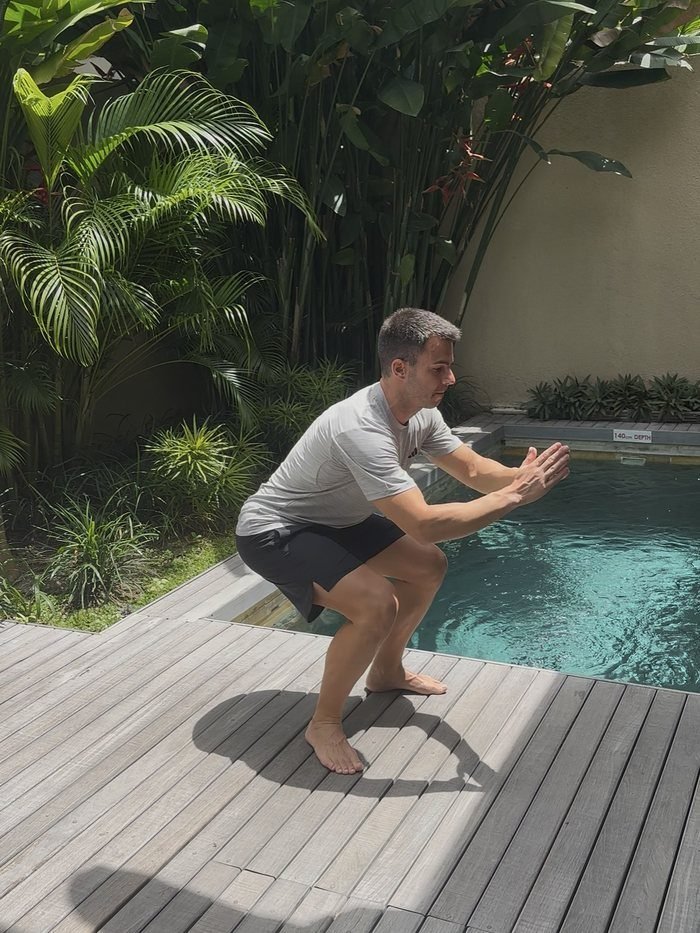

To start with, sitting down on a chair and standing up again is enough: what counts is that the muscle works.
Is this happening to you?
If you have been trying for a while and the number will not move, tell me. The first conversation is free and carries no commitment.
First call free · No commitment
If you take medication, read this
Exercise lowers glucose, and that has to be accounted for. If you inject insulin or take sulfonylureas (gliclazide, glimepiride, glibenclamide), you can have hypoglycaemia during exercise or several hours afterwards. Talk to your doctor before starting a new plan, measure before and after for the first few weeks, and always carry some sugar with you.
On metformin alone the risk of hypoglycaemia is very low.
Other situations worth checking first: advanced retinopathy (some very intense efforts may be inadvisable), neuropathy in the feet — check them daily and mind your footwear — and any known heart condition. None is a reason not to move. All are a reason to choose carefully how.
A starting plan for somebody doing nothing today
- Weeks 1–2: 10 minutes walking after your main meal. Every day. Nothing else.
- Weeks 3–4: raise it to 20 minutes and add one 15-minute strength session at home.
- Weeks 5–8: two strength sessions and 30 minutes walking, five days.
- From then on: maintain. You are already at the full recommendation.
Notice the first week is ridiculously easy. That is deliberate. The reason people quit is not that the plan is too soft: it is that they start too hard, burn out and drop it in week three.
What to expect
With exercise alone, without changing your diet, the expected HbA1c fall is around half a point when aerobic and strength work are combined. It is less than weight loss achieves, but it is real, it has very few side effects if you build up gradually, and it improves ten other things along the way.
And there is something that does not show in any blood test: moving also helps you sleep. You notice a little on the day you train and, with consistency, sleep quality improves. Sleeping better in turn helps your glucose. It all goes together.

Pablo Berna Sierra · Nurse, dietitian and trainer
Nursing registration no. 15794 · Colegio Oficial de Enfermería de Zaragoza
Over 14 years practising as a nurse and over a decade working with people with type 2 diabetes, prediabetes and excess weight. More about me.
Sources
5
- Tonga E et al. “Physical activity guidelines for adults with type 2 diabetes: systematic review”. Diabetes Research and Clinical Practice, 2025. View source
- American Diabetes Association. “Facilitating Positive Health Behaviors: Standards of Care in Diabetes”. View source
- Umpierre D et al. “Physical activity advice only or structured exercise training and association with HbA1c levels in type 2 diabetes”. JAMA, 2011. View source
- Dempsey PC et al. “Interrupting prolonged sitting in type 2 diabetes: nocturnal persistence of improved glycaemic control”. Diabetologia, 2017. View source
- Kredlow MA et al. “The effects of physical activity on sleep: a meta-analytic review”. Journal of Behavioral Medicine, 2015. View source
Please note. This article is for general guidance and does not replace consultation with your doctor or the treatment prescribed to you. Do not change your medication on your own.